Wisdom teeth removal
Careful assessment and clear treatment options for wisdom teeth that are painful, repeatedly infected or impacted, with straightforward advice on what to expect before, during and after treatment.
When wisdom teeth become a problem
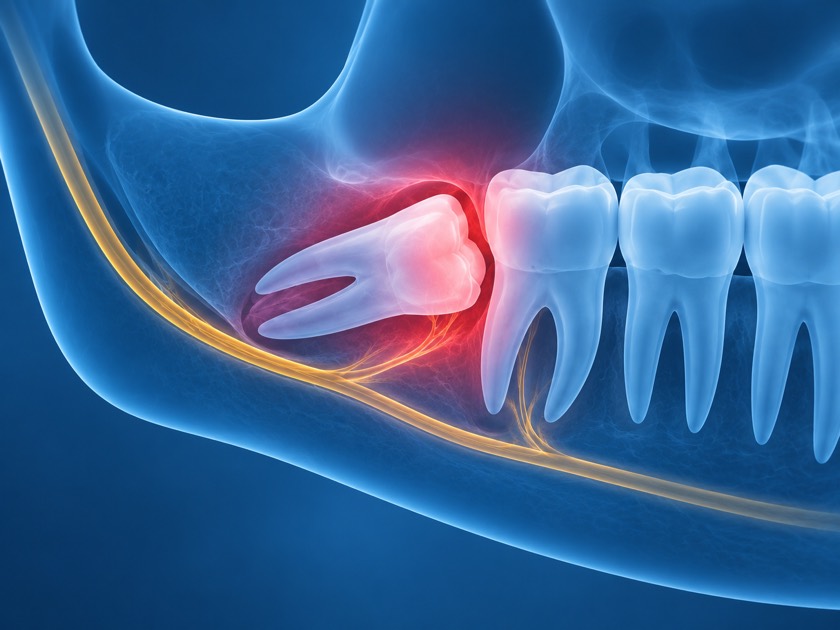
Wisdom teeth are the last teeth to develop, usually appearing in the late teens or early twenties. Sometimes there is not enough space for them to come through normally. They may grow at an angle, only partially emerge through the gum, or remain beneath the gum or bone. These are known as impacted wisdom teeth.
Not every impacted wisdom tooth needs to be removed. Treatment is usually considered when it is causing, or contributing to, problems such as:
- Repeated infection (pericoronitis) around a partially erupted wisdom tooth, which can cause pain, swelling, an unpleasant taste and difficulty opening the mouth.
- Tooth decay, either affecting the wisdom tooth itself or the neighbouring molar where access for cleaning can be difficult.
- Gum disease or bone loss around the wisdom tooth or the tooth immediately in front of it.
- Cysts or other changes developing around a buried or impacted tooth.
- Persistent pain or discomfort associated with the wisdom tooth.
Wisdom teeth that are healthy and not causing problems do not usually need to be removed. Your consultation is therefore about assessing the tooth carefully, understanding whether it may cause any harm, and deciding whether treatment or simply monitoring it is the most appropriate option.
Your assessment
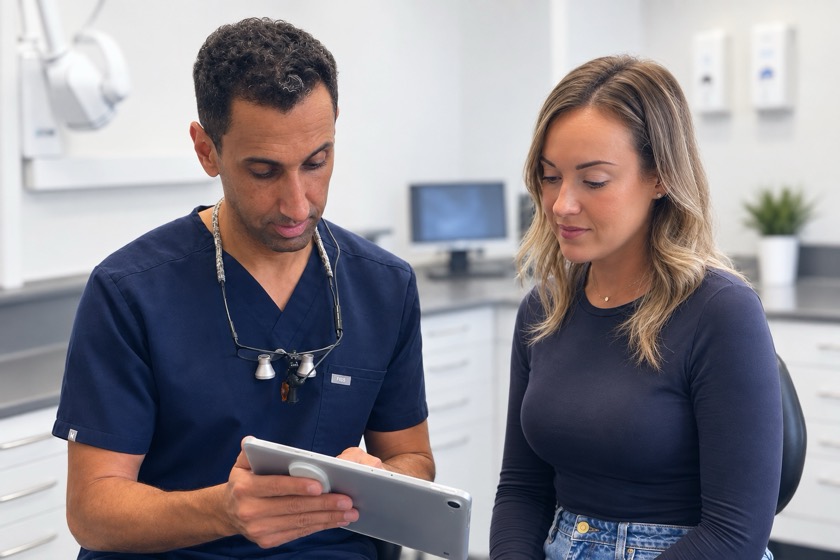
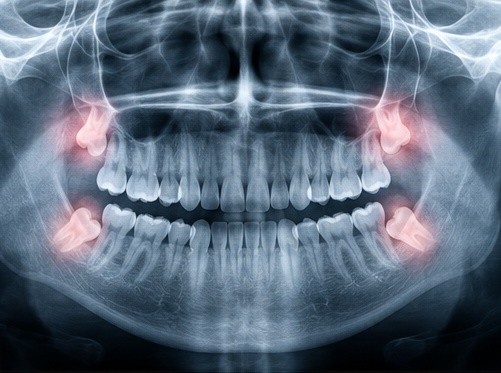
Your consultation starts with a discussion about your symptoms, concerns and dental history, followed by a clinical examination and appropriate imaging. A panoramic X-ray helps assess the position of your wisdom teeth and, for lower wisdom teeth, their relationship to the nerve that runs through the jaw.
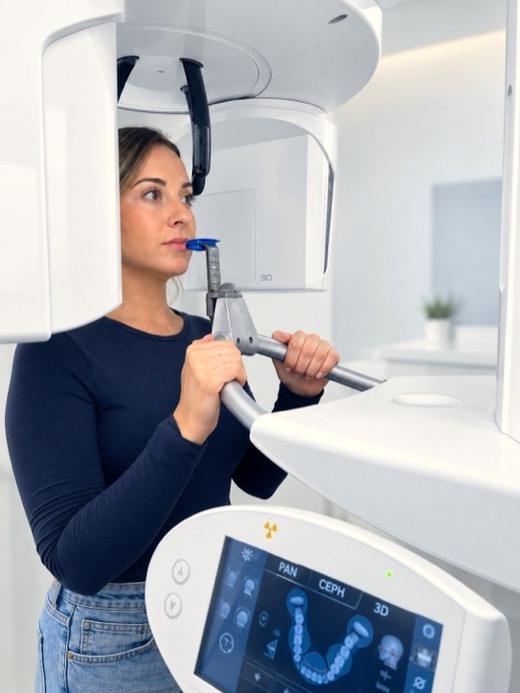
If the roots appear particularly close to the nerve, a 3D CBCT scan may be recommended to assess this relationship in greater detail before treatment is planned. CBCT imaging is available on site, so this can usually be arranged without the need to attend another clinic.
By the end of your consultation, you should have a clear understanding of your options, what treatment would involve, and the potential risks and benefits. Where appropriate, this may include alternatives to removal, such as monitoring the tooth or leaving it alone for the time being.
3D imaging and surgical planning
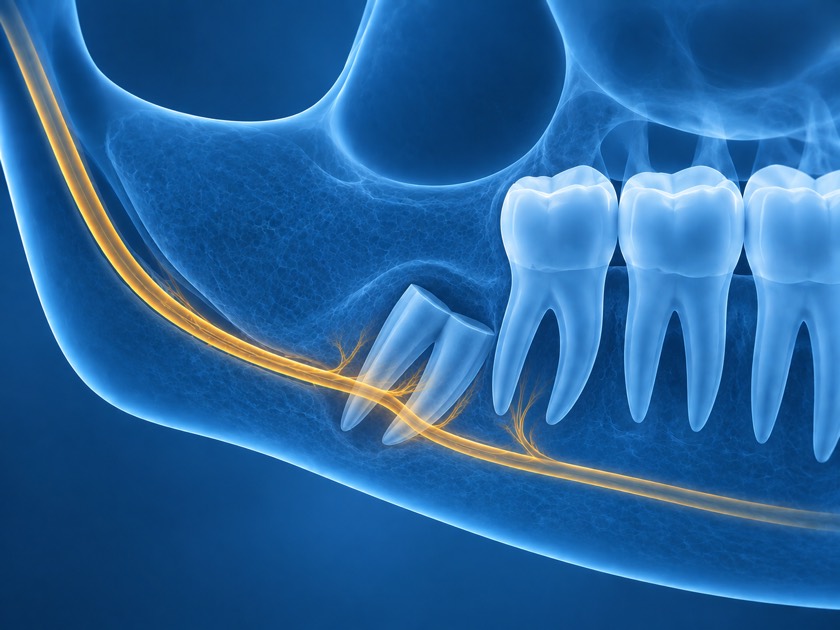
A panoramic X-ray provides a useful overview of the jaws and is often all that is needed to assess a wisdom tooth. However, when the roots of a lower wisdom tooth appear close to the inferior alveolar nerve, a two-dimensional X-ray cannot always show their exact relationship. The nerve may pass alongside, beneath or between the roots, and understanding this anatomy can be important when planning treatment.
Cone beam CT (CBCT) provides a detailed three-dimensional view of the tooth, its roots and the nerve canal. This allows their relationship to be examined from different angles and, where necessary, the distance between them to be assessed more accurately.
CBCT scanning is available on site. If a scan is required, it can often be taken during the same visit, without the need to attend a separate imaging centre. Sherif reviews the scan himself and will discuss the findings with you when planning your treatment.
How the scan helps
- Planning the procedure. Knowing the position of the nerve and the shape of the roots helps determine the safest and most appropriate surgical approach.
- Choosing the technique. In selected cases, the findings may influence whether complete removal or a coronectomy — removing the crown while deliberately leaving the roots in place — is recommended.
- Understanding your individual risk. The discussion can be based on your own anatomy and scan findings rather than general estimates alone.
The scan can be reviewed using dedicated three-dimensional planning software, allowing the nerve canal and its relationship to the wisdom tooth to be assessed carefully before surgery.
Sherif has a particular interest in three-dimensional dental imaging and co-authored a textbook on cone beam CT of the head and neck, alongside using CBCT routinely in clinical practice.
The procedure
Most wisdom teeth can be removed comfortably under local anaesthetic. The area is made completely numb and you remain awake throughout. You may feel some pressure or movement during the procedure, but you should not feel pain. Straightforward extractions can be relatively quick, while deeply impacted or more complex wisdom teeth may take longer.
If the tooth is beneath the gum or partly within the bone, a small incision is made to gain access. A small amount of bone may be removed where necessary, and the tooth can be carefully divided into sections to allow it to be removed through a smaller opening. Dissolvable stitches are usually placed at the end of the procedure.
Sedation for anxious patients
Feeling anxious about wisdom tooth surgery is very common. If this is something you are concerned about, let Sherif know at your consultation. Having time to understand the procedure and being guided through each stage is often enough to make treatment feel much more manageable.
IV sedation is available
For patients who need additional help with anxiety, intravenous (IV) sedation can be provided. A sedative is given through a small cannula in the hand or arm, helping you become deeply relaxed while remaining conscious and able to respond. Many patients remember very little, if anything, about the procedure afterwards.
Your suitability for sedation will be assessed beforehand, taking into account your medical history, medications and planned procedure. If you have IV sedation, you will also need a responsible adult to accompany you home and follow the aftercare arrangements discussed with you. Full detail on sedation.
Coronectomy
When the roots of a lower wisdom tooth are closely related to the nerve in the jaw, removing the entire tooth may carry an increased risk of nerve injury. In selected cases, a coronectomy can be considered as an alternative.
This involves removing the crown of the wisdom tooth while intentionally leaving the roots in place, reducing the need to disturb the nerve. Coronectomy is not appropriate for every tooth, particularly where there is infection involving the roots or other reasons why they need to be removed.
Sherif will assess your X-rays and, where required, a 3D CBCT scan to determine whether coronectomy or complete removal is the more appropriate option for you.
What recovery usually looks like
Recovery varies depending on the position of the wisdom tooth, the complexity of the procedure and how your body heals. As a general guide:
-
First 24 hours
Take things easy and avoid rinsing the mouth on the day of surgery. Soft, cool foods are usually most comfortable. A small amount of bleeding or oozing is normal, and some swelling may begin to develop. Take your recommended pain relief as advised.
-
Days 2–3
Swelling and jaw stiffness are often at their most noticeable during this period. Gentle warm salt-water rinses can usually be started from the following day. For many people, this is when discomfort peaks before gradually beginning to improve.
-
Days 4–7
Swelling and discomfort should continue to settle, and eating and opening the mouth usually become easier. Many people feel ready to return to work within a few days, although more complex surgery or physically demanding work may require additional recovery time.
-
Weeks 2–4
The gum continues to heal and any dissolvable stitches usually disappear. Although the area may feel largely healed, the bone beneath the gum continues to remodel and fill in gradually over the following months.
This is general information, not a prediction of your own recovery. You will be given written aftercare instructions specific to your procedure, along with a number to call if something does not feel right.
Questions about wisdom teeth
Does everyone need their wisdom teeth removed?
No. Many people keep their wisdom teeth throughout their lives without any problems. Removal is usually considered when a wisdom tooth is causing repeated infections, decay, pain, or damage to the neighbouring tooth. If a wisdom tooth is healthy, symptom-free and can be kept clean, it can usually be left in place and monitored.
How long will I need off work?
Most people need around two to three days to recover after a straightforward wisdom tooth extraction. More complex surgery, or a job involving physical activity, may require a little longer. Where possible, it is sensible to allow yourself a few quiet days after treatment to rest and recover.
Will I need a 3D scan?
Not necessarily. For many wisdom teeth, a panoramic X-ray provides all the information needed. A 3D CBCT scan may be recommended when the roots of a lower wisdom tooth appear particularly close to the nerve, allowing their relationship to be assessed in much greater detail.
CBCT scanning is available on site and, when required, can often be carried out during the same visit without the need to attend a separate imaging centre. A scan is only recommended when the additional information is clinically useful and may influence how your treatment is planned. More on 3D imaging and planning.
What are the risks?
Some swelling, bruising, discomfort and jaw stiffness are common after wisdom tooth removal and usually settle as healing progresses. Less commonly, the socket can become painful during healing, a condition known as dry socket.
With lower wisdom teeth, there is also a risk of altered sensation affecting the lip, chin or tongue because of the nearby nerves. This is usually temporary, although in rare cases it can be long-lasting or permanent. Your individual risk will be assessed from your examination and imaging and discussed with you clearly before you decide whether to proceed.
Can I eat normally afterwards?
For the first day or two, soft foods are usually most comfortable while the area begins to heal. Try to avoid chewing directly over the surgical site, then gradually return to your normal diet as you feel able.
Smoking should be avoided during the early healing period, as it can increase the risk of problems such as dry socket. It is also best to avoid drinking through a straw for the first few days.
Do I need a referral from my dentist?
No. Sherif accepts referrals from dentists and GPs, but you can also contact the practice directly to arrange a consultation without a referral.
Concerned about a wisdom tooth?
A consultation can help determine whether treatment is necessary and, if so, explain your options and exactly what treatment would involve.